
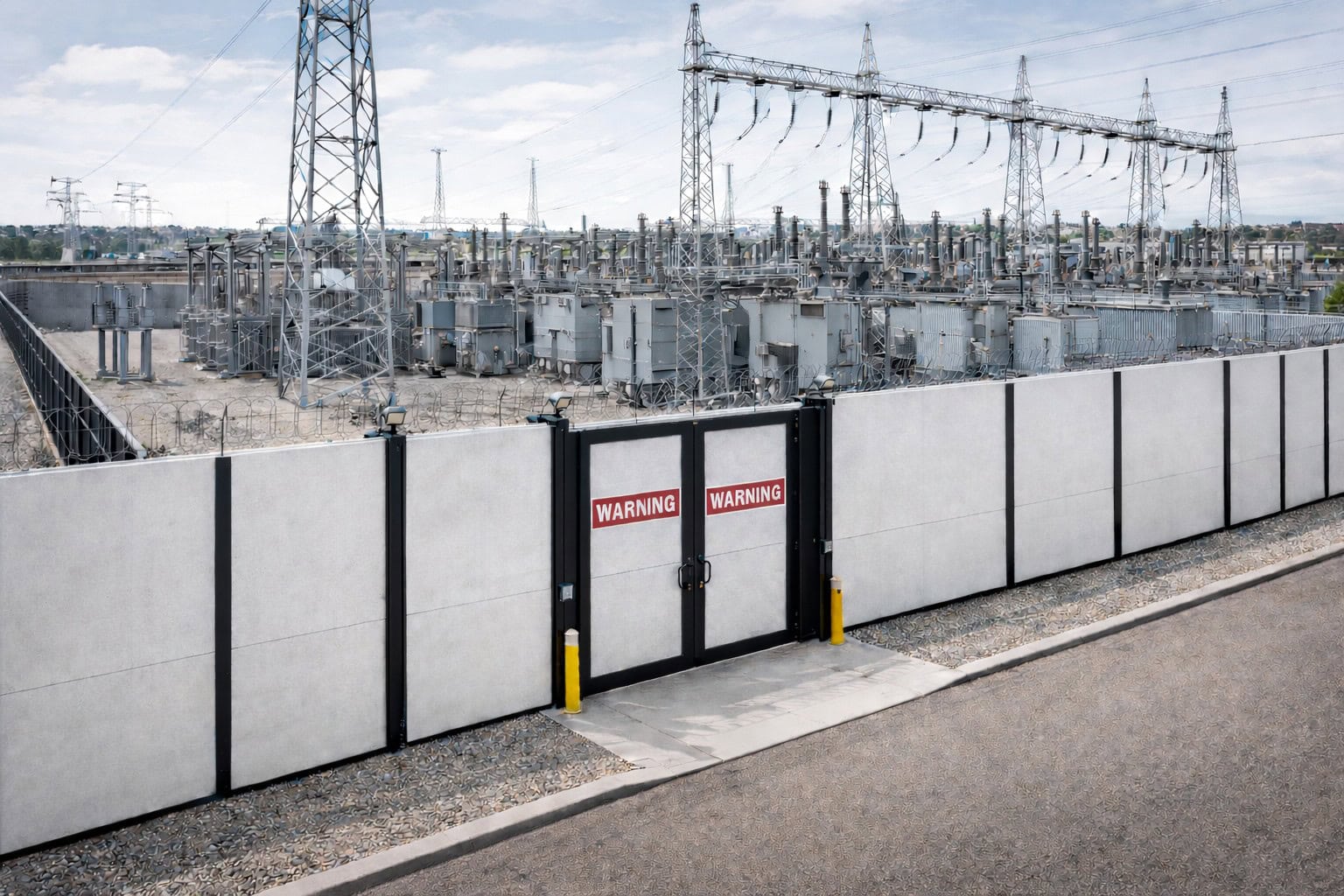
Electrical substations are essential to grid reliability, yet they remain some of the most vulnerable points in the overall power system. As targeted attacks become more frequent and more sophisticated, utilities are reassessing how they protect critical equipment. A substation attack can disable transformers, disrupt regional power supply, and create days or even weeks of outages that impact homes, schools, businesses, and emergency services.
For many utilities, hardened ballistic barriers are critical to modern physical security strategies. UL 752 Level 7 and Level 8 composite panels, including those engineered by ArmorCore, help shield transformers, control houses, and perimeter points from gunfire and forced entry. Level 8 is the most commonly specified standard for substation protection because it can withstand repeated high-powered rifle rounds.
Growing Threats to Electrical Substations
The increase in physical attacks on substations has been documented for more than a decade, and each year brings new attempts to breach or disable grid infrastructure. Damage ranges from vandalism to coordinated firearm assaults aimed at taking down large sections of the electrical system.
Many utilities still reference the 2013 Metcalf incident as a turning point. That’s the year that gunmen targeted Pacific Gas & Electric’s Metcalf transmission substation in Coyote, California, firing on 17 transformers and causing more than $15 million in damage. Although the perpetrators were never identified, the attack exposed how quietly and quickly a small group could attempt to destabilize the grid. Federal regulators responded with new physical security standards, and states followed with their own requirements.
A Timeline of Notable Attacks and Regulations
Despite efforts to thwart would-be attackers, reports show a continuing rise in substation threats across the country:
- April 2013 – Metcalf, California
- Gunmen fire on 17 transformers, causing extensive damage and triggering national concern.
- Becomes the catalyst for federal physical-security regulations.
- March 2014 – FERC Directs NERC to Develop Standards
- FERC orders NERC to submit a physical security reliability standard within 90 days, which is considered unusually rapid for regulatory development.
- July 2014 – FERC Orders Further Improvements
- NERC is directed to strengthen its proposed critical-infrastructure requirements.
- November 2014 – CIP-014 Standard Approved
- Requires transmission owners to assess risks, identify critical facilities, evaluate vulnerabilities, and implement security plans.
- June 2015 – California Legislation (SB-699)
- Adds state-level physical security requirements for substations.
- September 2016 – Utah Transformer Shooting
- An eco-terrorist attack that damages equipment and triggers a blackout.
- The attacker admitted the intent was to strike multiple substations in one day.
- Summer 2021 – “Lights Out” Plot, Foiled by FBI
- A white supremacist group planned coordinated attacks on substations nationwide, but were stopped before the plan could be carried out.
- 2022 – A Growing Wave of Attacks
- November: Thanksgiving vandalism at an Oregon substation.
- December 3: Coordinated shooting attack in Moore County, North Carolina, leaves 45,000-plus without power for up to four days.
- December 25: Two Washington state substations attacked on Christmas, causing millions in damages.
- 2023 – Record Incidents
- 185 reported physical attacks or credible threats, doubling 2021 levels.
The Benefits and Importance of Bullet-Resistant Barriers
Ballistic protection plays a crucial role in safeguarding equipment and maintaining grid reliability. Key benefits include:
- Preventing firearm penetration through transformer radiators and control house walls.
- Reducing the risk of catastrophic transformer failure caused by projectile damage.
- Supporting faster restoration during emergency events.
- Limiting access and line-of-sight exposure to critical components.
- Strengthening compliance with physical security frameworks such as CIP-014.
- Providing long-lasting, corrosion-resistant protection that holds up in remote or harsh environments.
Applications of ArmorCore’s Bullet-Resistant Panels
ArmorCore’s UL 752 Level 7 and Level 8 panels have been used in multiple utility hardening projects, including new builds, targeted retrofits, and full substation redesigns. Common applications include:
- Transformer shielding walls that stop repeated shots from high-powered rifles.
- Control house reinforcement to protect protective relays and SCADA systems.
- Ballistic retrofits inside existing control structures without major reconstruction.
- Perimeter upgrades that integrate with fencing and restrict clear lines of fire.
- Modular ballistic partitions that can be installed quickly during outage windows.
- Hybrid systems combining concrete, steel, and composites to meet advanced threat scenarios.
Utilities have installed ArmorCore panels around transformers in high-risk corridors and distribution hubs, as well as at remote rural sites where response times may be delayed. Panels have also been integrated into custom structures designed specifically for Level 8 performance and NERC reliability needs.
Top-Quality Ballistic Protection from ArmorCore
As grid hardening becomes a top priority nationwide, utilities rely on materials that balance strength, safety, ease of installation, and long-term durability. ArmorCore’s composite ballistic panels are engineered to meet UL 752 requirements, perform in extreme conditions, and integrate seamlessly into both new infrastructure and retrofit designs.
If you’re evaluating substation protection options or planning a security upgrade, the ArmorCore team can help you select the right solution for your site conditions and regulatory environment. Contact us or request a quote to get started.